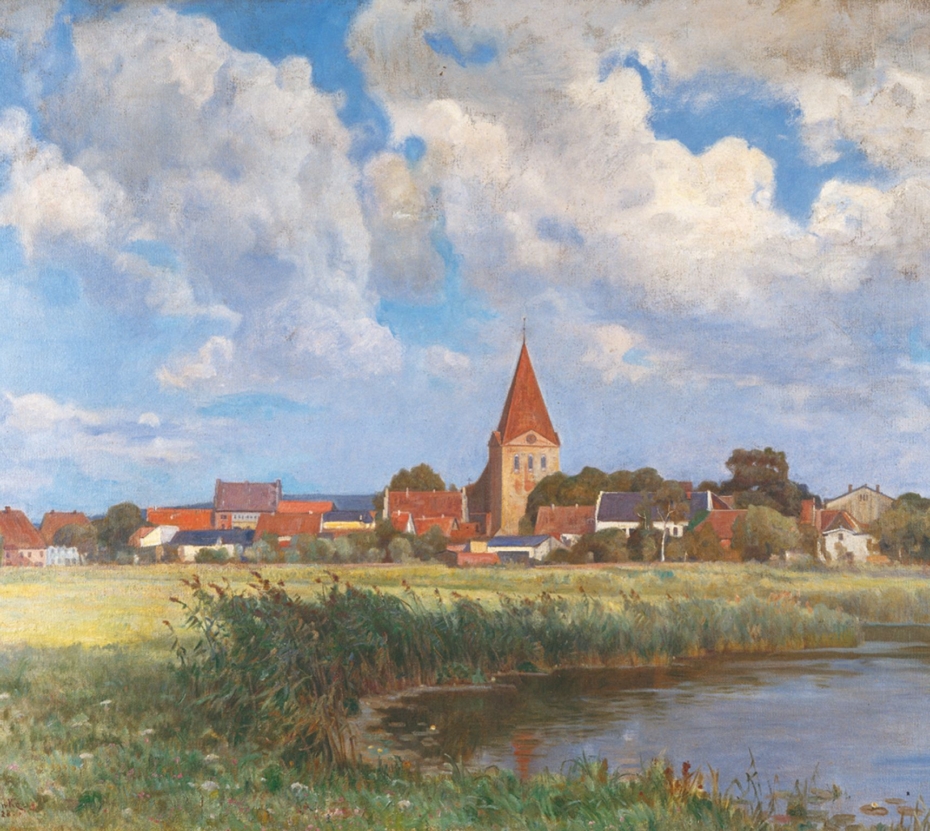
INFOFLASH 88 – BARBIZON: European Artist’s Colonies in the spotlight Exhibition: “From Studio to Landscape”
Espace-Hôtel L’esquisse (September 21, 2024 – February 2, 2025)
Artists’ colonies in Europe, an early 19th century phenomenon that lasted 175 years, numbered over 130 in total. Despite the considerable distance between them and their diverse cultural traditions, they had many creative accomplishments in common. They were often born of a personal encounter, friendship, or by chance, and were formed around a common interest or artistic purpose.
Some were based in summer resorts, but they were as different in their settings as in their evolution over time. Directly inspired by their stay in Barbizon, Camille Van Camp and Hippolyte Boulenger founded an artists’ colony in Tervuren, in the forest of Soignes, near Brussels. In Germany, the artists of Frankfurt who shunned the increasing industrialisation of the city, discovered the village of Kronberg, a model of a ‘healthy and natural world’.
The village was one of the first German artists’ colonies and the meeting place of many artists. Further north, two painter friends, Oskar Frenzel and Paul Müller-Kaempff, discovered the fishing village of Ahrenshoop, perched on the cliffs of the Baltic, while hiking. The village of Worpswede was only discovered by artists at the end of the 19th century and fascinated visitors with its mysterious peatland Teufelsmoor until the end of the Second World War. Despite the differences in landscape, traditions and history, the artists’ colonies provided the settings for an artistic revival that revolutionised art throughout Europe, both in practice and in style.
It was only after two World Wars and a long period of recovery that their importance was again recognized.
Although Barbizon, Tervuren, Kronberg, Ahrenshoop and Worpswede were the frontrunners, acknowledging their importance is a way to pay tribute to all classical and modern artists’ colonies in Europe.
- INFOFLASH 88 – BARBIZON: European Artist’s Colonies in the spotlight Exhibition: “From Studio to Landscape”INFOFLASH-88-E-Barbizon.pdfAdobe Acrobat Document [578.1 KB]Download